




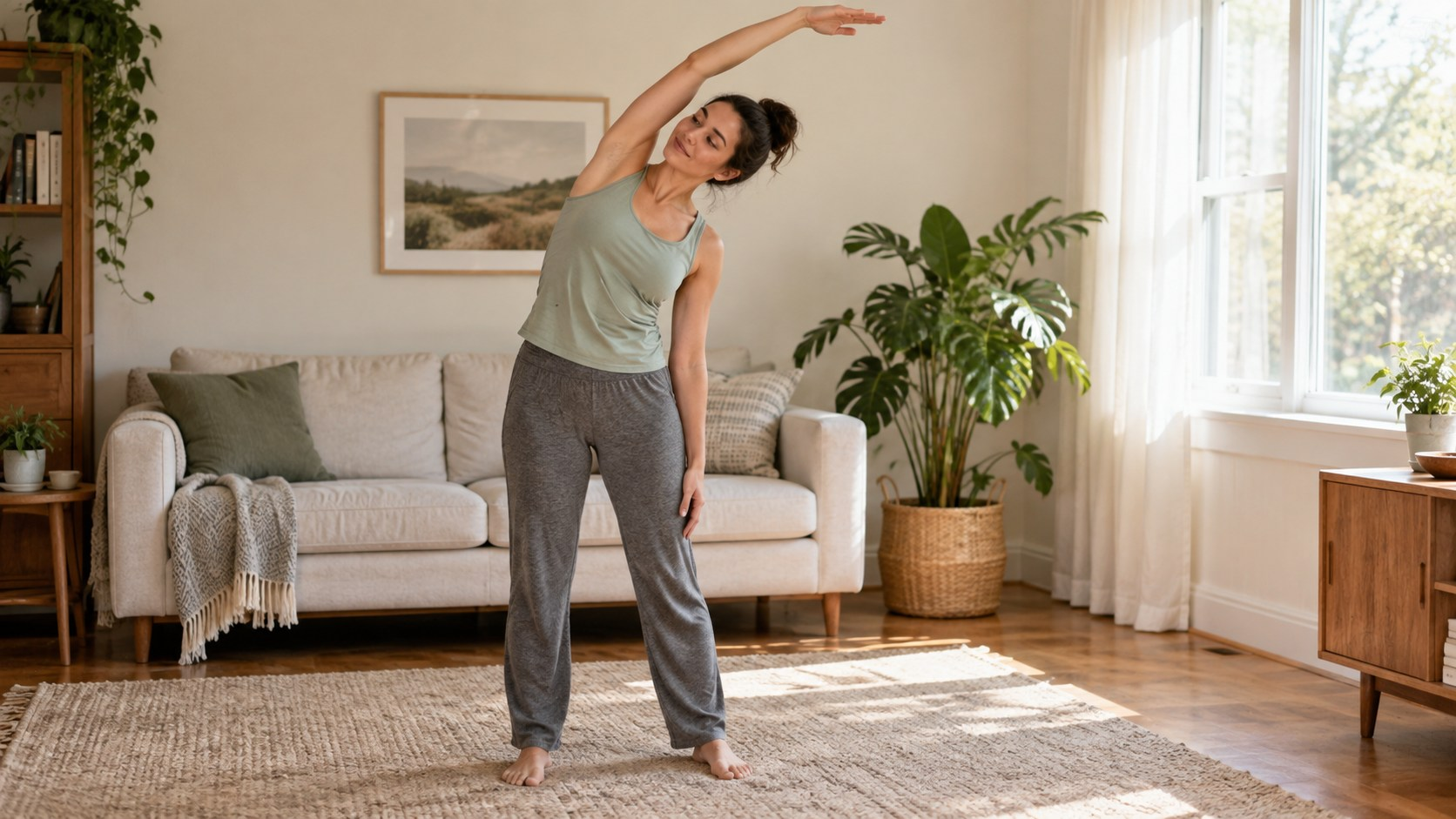
You do not need an hour of yoga to feel more comfortable moving in the morning. A short routine can help you notice where you feel stiff, move your joints gently, and ease into the day. The goal is a comfortable range of motion, not the deepest stretch you can manage.
This eight-move routine takes about 12 to 15 minutes. It begins with easy movement, then works from your shoulders down to your calves. You can do it at home with a chair, a wall, and a towel.
Before You Start
Walk around your home or march gently in place for three to five minutes. Muscles generally stretch more comfortably when they are warm. Move slowly, breathe normally, and never bounce. You should feel a mild pull during a stretch, not sharp pain. The American Heart Association recommends beginning with easy walking if stretching is your only activity.
For the held stretches below, start with 10 to 15 seconds per side. As they become comfortable, work toward about 30 seconds. If you have an injury or a condition that affects movement, ask a healthcare professional which exercises are appropriate for you.
1. Gentle Neck Tilt
Sit or stand tall with your shoulders relaxed. Slowly tip your right ear toward your right shoulder until you feel a light stretch along the left side of your neck. Keep both shoulders down and face forward. Hold briefly, return to the center, and repeat on the other side.
Let the weight of your head create the movement; there is no need to pull it with your hand. Use a smaller tilt if your neck feels sensitive. Avoid rolling your head in a full circle or pushing through discomfort.
Try: One or two gentle holds on each side.
2. Shoulder Rolls
Let your arms hang comfortably. Draw your shoulders up, back, and down in a slow circle. Complete five rolls, then reverse direction for five more. Keep your jaw relaxed and avoid turning the movement into a shrug that stays near your ears.
Shoulder rolls are a useful transition from standing still to moving more freely. They can also help you notice whether one side feels different from the other. There is no need to force both shoulders to move identically.
Try: Five circles in each direction.
3. Cat–Cow
Place your hands and knees on a comfortable surface, with your hands roughly beneath your shoulders and your knees beneath your hips. As you breathe out, gently round your back and let your head follow the movement. As you breathe in, slowly move in the opposite direction, lifting your chest slightly while keeping your neck comfortable.
Move through a range that feels easy. The aim is to move your spine, not to press it into an extreme arch. If kneeling is uncomfortable, sit near the front of a sturdy chair and alternate between gently rounding your back and lifting your chest.
Try: Five to eight slow cycles.
4. Doorway Chest Stretch
Stand in an open doorway and place your forearms or hands against the frame at a comfortable height. Step one foot forward until you feel a light stretch across the front of your chest. Keep your ribs relaxed and avoid pushing your shoulders into a painful position.
If the doorway feels too intense, lower your arms or stretch one side at a time. This is a particularly practical move before a day spent working at a desk because it asks your upper body to move out of its usual seated position.
Try: Hold for 15 to 30 seconds.
5. Seated Upper-Body Turn
Sit upright in a sturdy chair with both feet on the floor. Cross your arms loosely over your chest. Turn your shoulders a little to the right while keeping your hips facing forward. Return to the center, then turn left.
Keep the movement small and controlled. Think of turning through your upper back rather than pulling yourself around with your arms. Stop if the movement produces back pain, dizziness, or a pinching feeling.
Try: Five gentle turns on each side.
6. Half-Kneeling Hip Flexor Stretch
Kneel with one knee on a folded towel and place the other foot in front of you. Hold a chair or wall for balance. Gently shift your weight forward until you feel a mild stretch at the front of the hip on the kneeling side. Keep your torso upright rather than arching your lower back.
If kneeling is uncomfortable, use a standing version: take a short step backward, bend your front knee slightly, and shift forward while holding a stable surface. You should feel the stretch near the front of the rear hip, not pressure in your lower back.
Try: Hold for 15 to 30 seconds per side.
7. Lying Hamstring Stretch
Lie on your back with one knee bent and that foot resting on the floor. Lift the other leg and hold behind your thigh, or loop a towel around the foot. Slowly straighten the lifted leg only as far as is comfortable. A slight bend in the knee is fine.
You should feel a gentle pull along the back of your thigh. If you feel strain behind the knee or in your lower back, bend the lifted knee more or lower the leg. Switch sides without rushing.
Try: Hold for 15 to 30 seconds per side.
8. Wall Calf Stretch
Face a wall and place your hands against it. Step one foot back, keeping the heel on the floor and the toes pointing forward. Bend your front knee slightly and lean toward the wall until you feel a stretch in the back calf.
Keep the movement comfortable and avoid forcing your heel down. After holding the first side, switch legs. This final stretch is an easy way to finish the routine before walking into the rest of your day.
Try: Hold for 15 to 30 seconds per side.
Make the Routine Fit Your Morning
Eight moves are a menu, not a test you have to pass. On a busy day, warm up briefly and choose the three or four movements that feel most useful. On another day, repeat the full sequence. Consistency matters more than trying to stretch harder.
Keep a chair nearby for balance, use a folded towel under your knees, and shorten any hold that feels uncomfortable. Notice how you feel afterward: the routine should leave you ready to move, not exhausted or sore.
Stretching can improve flexibility and joint range of motion, but it does not replace walking, strength training, or medical care for persistent pain. Mayo Clinic advises warming up first, breathing through each stretch, avoiding bouncing, and easing back when a movement hurts.
Frequently Asked Questions
Is it okay to stretch right after waking up?
Yes, but begin with a few minutes of easy walking or marching in place before holding stretches. Start gently and give your body time to wake up.
Should morning stretches hurt?
No. A mild pulling sensation is normal; sharp pain or joint pain means you should stop or reduce the range of motion. Avoid bouncing or trying to reach farther with every breath.
Do I need to do every move daily?
No. Choose movements that suit your body and schedule. A shorter routine you can repeat comfortably is more useful than an ambitious one you rarely do.
How long should I hold each stretch?
If you are new to stretching, begin with about 10 to 15 seconds. You can gradually work toward 30 seconds while breathing normally and staying within a comfortable range.